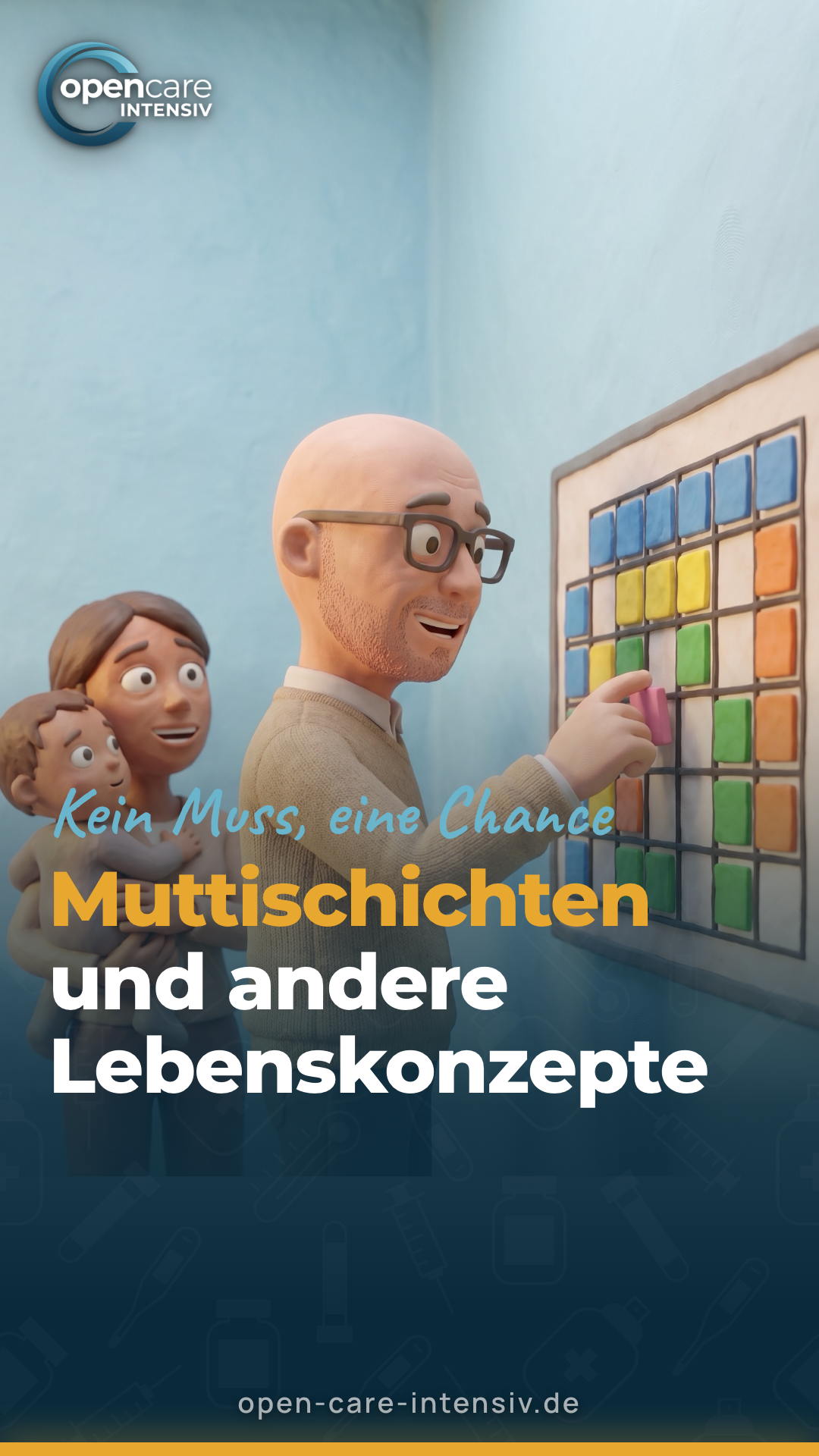
Mum shifts in intensive care: potential, not a problem
· Igor Savitsky
Mum shifts are inefficient and unworkable? That is simply not true. Flexible working hours that are based on real-life situations are not a disadvantage for a care team. They are an opportunity to attract people who would otherwise not enter the job market at all. Especially in intensive care, where skilled professionals are scarce, it pays to look closely.
Why mum shifts are not a luxury in Alpen and on the Lower Rhine
Igor, managing director and director of nursing at Open Care, regularly hears questions from the team: Why do I have to work so many days in a row? Why early and late? Why at the weekend, and not my colleague? His answer is clear: none of it is a must. Every shift decision is based on voluntary agreement, not on pressure.
But then he asks a question in return. Would you rather have someone on the team who really fits in, who is fun to work with, who will also step in in an emergency? Or someone who simply takes on every shift without restriction? The team's answer is always clear: team fit comes before availability.
This is exactly where the argument for mum shifts comes in. If someone can only work from morning until noon because the children come home from school in the afternoon, that person is still a valuable professional. They bring competence, reliability and real commitment. The alternative would be: this person stays away from the job market. Intensive care cannot afford that.
What does this mean for shift planning?
Yes, mum shifts make planning more complicated. That is not sugarcoating. Someone who is only available for four hours in the morning does not fill a classic early or late shift. That means more coordination, more arrangement, more creativity in the duty roster.
But: that is the task of management, not the problem of the employees. Igor sees it as his job as managing director and director of nursing to close exactly these gaps. Not by building up pressure, but by creating structures that reflect real-life circumstances.
Specifically, that means: advertising new positions, adapting shift models, planning overlap times. It means more effort in the office. But it also means a stable team that stays, instead of resigning again after six months.
Which other life arrangements are part of this?
Mum shifts are just one example. The principle applies to all life arrangements that differ from the classic full-time job. Someone who is only looking for night shifts because they care for relatives during the day. Someone who can only take late shifts because the daycare drop-off is in the morning. Someone who works part-time because a second source of income is part of the picture.
All of these people are present on the care job market in regions such as Wesel, Moers or Kamp-Lintfort. They are looking for employers who meet them halfway. When employers say that is too complicated for us, they lose exactly these professionals. And with that, the entire care system loses.
The care job market is under pressure. Broader analyses of the skilled labour shortage in the sector also show this. Those who ignore potential now make the problem worse. Those who think flexibly draw from a talent pool that others do not see. That is not charity, that is strategic action.
What managers in care can take away from this
The message is expressly also aimed at managing directors and supervisors of other care services. Anyone who judges whether a life arrangement is legitimate is thinking in the wrong direction. The question is not: Is this convenient for us? The question is: How do we adapt so that this person can work for us?
This requires a rethink in management culture. Availability is not a measure of quality. Someone who is reliable and professionally strong brings more than someone who would theoretically be reachable at any time but has long since checked out inwardly.
Gratitude in a team does not arise through control. It arises when people feel that their real-life circumstances are taken seriously. That creates loyalty. And loyalty is worth real money in intensive care, where onboarding is laborious and turnover is expensive.
If you would like to delve deeper into the topic of the care job market, it is worth taking a look at the Bertelsmann study on the skilled labour shortage in care.
How Open Care puts this into practice
At Open Care in Alpen, this is not a concept on paper. It is lived practice. Mum shifts are built in, even if that makes the duty roster more complex. Requests for night shifts only are taken seriously. Anyone who is only available at weekends because they have another commitment during the week gets an offer instead of a rejection.
This presupposes that the gaps left by flexible models are actively filled. Through targeted new hires, through clever overlaps, through management that sees coordination as its own task and does not pass it on to the team.
The goal: a team that truly sticks together. In intensive care, it is about people who need to be cared for around the clock. That requires colleagues who step in for one another. That happens voluntarily when the company has also stepped in for them.
Do you work in care and are looking for an employer that truly takes your life situation into account? Or do you want to know how Open Care organises intensive care around Alpen and the Lower Rhine? Just get in touch, we will talk openly with each other.
Frequently asked questions
What is a mum shift in care?
A mum shift is a shortened shift timed to suit the needs of parents, for example only from morning to midday. It makes it possible to combine family and work without having to rely on a full-time job.
Do mum shifts make sense for care services?
Yes, even though they make shift planning more laborious. They make it possible to win skilled professionals who would otherwise stay away from the labour market. In a market with a skilled labour shortage, that is a real advantage.
What happens to the gaps in the duty roster that flexible shifts leave behind?
That is a management task. Gaps are closed through targeted new hires, shift overlaps and creative duty roster design. It is not the employees' job to fill these gaps themselves.
Does this apply only to parents or also to other life situations?
The principle applies to all real-life situations: night shift only, weekends only, late shifts only, or part-time models with other commitments. Anyone who wants to use potential does not look at the template, but at the person.
How can you find out as a registered nurse (Pflegefachkraft) whether an employer is truly flexible?
It is best to ask directly in conversation: Which shift models are possible? How does the company handle individual requests? Anyone who answers evasively or immediately insists on full-time is already giving a clear answer.