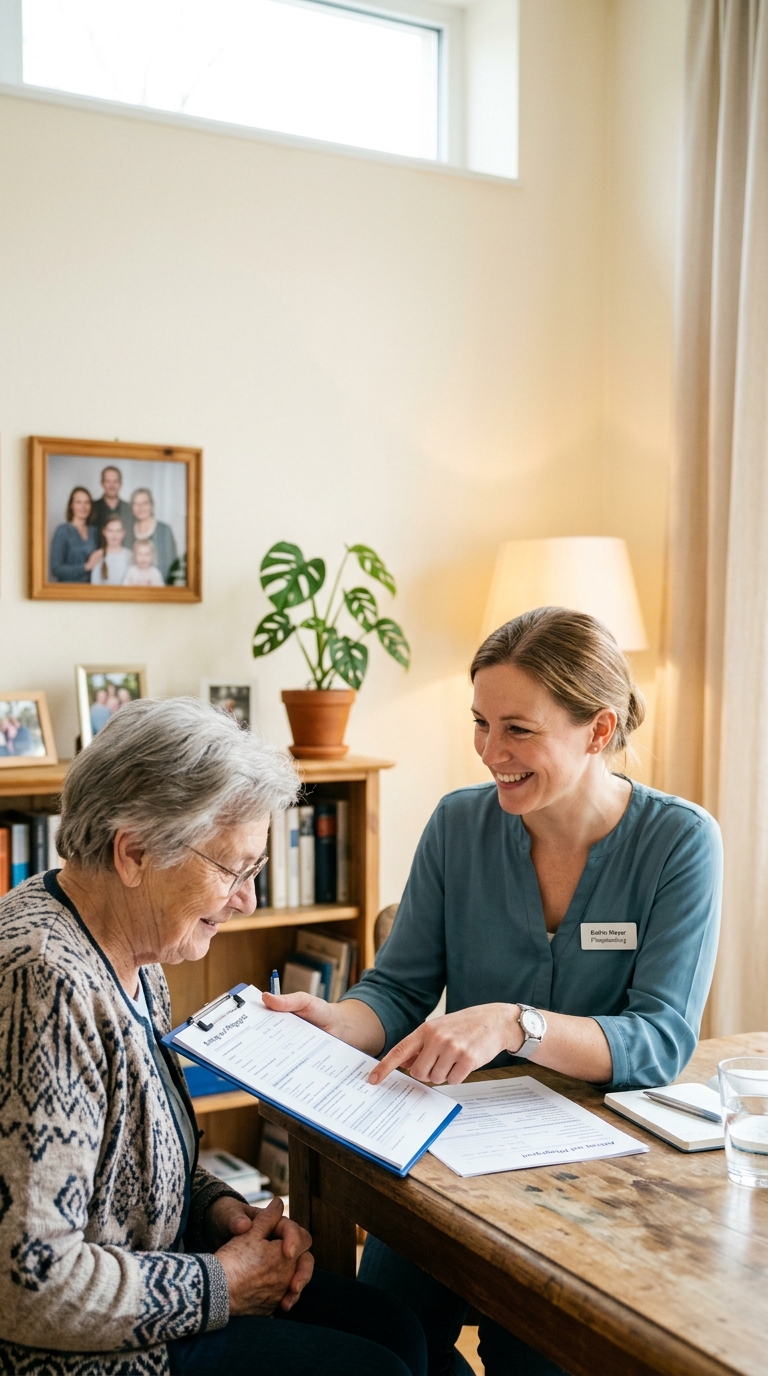

Care counselling & family training
Independent & competent for your family – free of charge and with heart.
We advise everyone who organises or provides care
Six target groups – one goal: the highest possible quality of life for you and your family.
Adults with a care level (Pflegegrad)
Secure your independence! Our counselling shows you how to make the best use of benefits so you can live at home self-determined for as long as possible. We clarify your entitlements and give you confidence in high-quality care.
Family caregivers
Caregiving takes enormous strength. You don't have to manage it alone! We show you ways to get relief, explain how to use aids, and make sure you don't lose sight of your own health. Get the support you need!
Groups & family members
Stronger together: In training sessions and group counselling, you learn not only care techniques but also benefit from valuable exchange. We provide the necessary expertise to make shared care safe and competent.
Children with a care level (Pflegegrad)
Special heroes need special protection. We support families in organising the best possible support for their child. We guide you through the bureaucracy so that more precious time remains for family life and love.
People with dementia or cognitive impairments
Here, counselling under § 7a SGB XI (case management) is extremely important, as needs are often more complex than with purely physical limitations.
Preventive counselling (without a care level (Pflegegrad))
We support you comprehensively in preparing for the care level (Pflegegrad) assessment – from the initial orientation conversation to accompanying you during the on-site assessment. Counselling under § 7a is also available to insured persons for whom a care level (Pflegegrad) is foreseeable. This way you set the course early, before an emergency occurs.

Home is where the heart lives.
Suddenly everything is different
A care case in the family raises questions: What funds are we entitled to? How do I learn the right techniques? What does the long-term care insurance fund (Pflegekasse) require of me?
After all, growing older with dignity in your own home, surrounded by your loved ones, is the best thing there can be.
Familiar surroundings
Growing older with dignity in your own home – surrounded by your loved ones.
Safe & self-determined
We give you guidance so that care at home stays stable.
With peace of mind
Expertise, experience and genuine humanity – hand in hand.
Five building blocks. One goal: your security
From mandatory visits to care level (Pflegegrad) applications – we take you by the hand and handle the bureaucracy.
§ 37.3 SGB XI · Mandatory visit
Counselling visit (Beratungseinsatz) for care allowance recipients
We come to your home, secure your entitlement to care allowance and give valuable tips for everyday life. Our regular counselling visits (Beratungseinsatz) serve to ensure the quality of care – we assess the care situation, give practical recommendations and reliably forward the counselling record to your long-term care insurance fund (Pflegekasse).
§ 7a SGB XI · Case support
Your personal care roadmap
Together we draw up a care plan, help with applications for care levels (Pflegegrad) and coordinate aids. We support people in need of care and their relatives on all matters concerning benefits, applications, care planning and relief services.
§ 45 SGB XI · Care training
Confidence for family caregivers
We show you important techniques (e.g. back-friendly lifting) and how to use aids, right in your own home. Family caregivers receive individual training in the home environment – we teach practical skills and strengthen families for their everyday care.
Care level (Pflegegrad) management
Initial application, upgrade & appeal
We guide you through the entire process: from the initial assessment and structured preparation for the assessment appointment to the professional justification of an appeal. We won't leave you alone in the jungle of regulations.
Child & youth care counselling (Pflegeberatung)
Support for little heroes & strong parents
A care level (Pflegegrad) is not a question of age. Even with neurodivergence such as ADHD, autism or developmental delays, you are entitled to care allowance and additional support. We help you present the "additional needs" correctly to the MD.
Sounds like what you're looking for?
We take the time for your concerns – personally, without obligation and free of charge.
Professional care counselling for a strong home
Our appeal to you: don't just meet the legal minimum, but make use of your full entitlement to regular expert checks. This creates a strong foundation for your care and gives you the certainty that someone is always at your side who looks closely.
Ten reasons why families trust us
What awaits you with us – and what sets us apart from the off-the-shelf.
Practical tips
Care tips for your everyday life
We are experts in care and counselling. With practical tips, we make your everyday life noticeably easier – for a better quality of life and a healthy care environment right in your own home.
Safe & long-term
Plan home care reliably
Our goal is for you to be able to stay in your familiar surroundings for as long as possible. We advise on home adaptations and relief services – so that care at home does not become overwhelming.
MD assessment
Your appointment without fear
The visit from the Medical Service often causes uncertainty. We prepare you thoroughly, go through the criteria and give tips on documentation. That way you go into the interview confident and well prepared.
Managing your care level
Upgrades & appeals
Does your care level (Pflegegrad) still match the actual effort required? We professionally analyse your needs and support you with upgrade applications or appeals – with our expertise as an intensive care provider.
Finances under control
Make full use of insurance benefits
Care allowance, benefits in kind, relief allowance (Entlastungsbetrag) – we keep track of everything. We explain which budgets you are entitled to and how to combine them optimally – so that nothing is lost.
Help with paperwork
We handle your care applications
Official forms are often complicated and take time. Without experience, entitlements are lost. We help you fill them out and explain technical terms clearly – quickly and without frustration.
Automatic proof
Receive your care allowance securely
Anyone receiving a care allowance must provide proof of counselling visits. We take the effort off your hands: after our conversation, we immediately send the confirmation digitally to your long-term care insurance fund (Pflegekasse) – on time, without reductions.
No time pressure
Empathetic counselling with time
Care is a matter of the heart. That is why we take time for you – without watching the clock. We listen, even when it comes to emotional strain. With us, you as a person are at the centre.
Trust through consistency
One dedicated contact person
You receive a dedicated contact person who knows your situation and story. No explaining yourself to new faces – we build a genuine bond and reliably support you over the long term.
Immediate help
Quick appointments when it counts
When a care situation changes, things have to move fast. Our commitment: prompt appointments, whether by phone, email or home visit. We quickly find an appointment that fits your daily life.
Let's talk.
Whether it's a mandatory § 37.3 visit, § 7a counselling or training – we'll find the right way.
Out-of-hospital intensive care (außerklinische Intensivpflege) as your advantage
In addition to general home care, we have many years of experience in out-of-hospital intensive care (außerklinische Intensivpflege). This knowledge helps us to safely support even complex situations – e.g. with ventilation, tracheostomy, neurological conditions, vigil coma and increased need for assistive devices.
This expertise complements our counselling work and enables competent support in all care situations – from basic care (Grundpflege) to highly complex care.
Seven qualities in one team
- Care experts with broad practical experience
- Further-trained care counsellors in accordance with § 7a SGB XI
- Certified trainers in accordance with § 45 SGB XI
- Experience in home care and complex care situations
- Holistic view of care, family and everyday life
- Reliable communication with long-term care insurance funds (Pflegekassen)
- Counselling that relieves, strengthens and provides orientation
How a counselling visit works
A simple 4-step plan – so that the first step comes easily.
Get in touch
Call us or use the form. We will get back to you within a very short time.
Home visit or conveniently by phone
You decide: We come to you in your familiar surroundings or advise you by phone to save time – thoroughly and individually.
Follow-up visit
Also possible by phone on request – convenient, time-saving, without preparation stress.
Gain confidence
We answer all your questions and handle the bureaucracy with the insurance funds – you keep a clear head.

Experienced, qualified and personally at your side
Madeleine is your dedicated contact person – with extensive expertise in home care, care counselling (Pflegeberatung) and out-of-hospital intensive care (außerklinische Intensivpflege). Thanks to her further training, she guides you safely and clearly through all questions about care, relief and support.
Care counsellor in accordance with § 7a SGB XI
Further trained for individual case counselling – with an eye for the big picture.
Trainer under § 45 SGB XI
Certified to instruct family caregivers directly in their home environment.
Experienced in complex care
Many years of practice in home care and out-of-hospital intensive care (außerklinische Intensivpflege).

Secure your care allowance. Clarify applications. Finally breathe easy
Initial consultation non-binding and free of charge. In person at your home or conveniently by phone – you decide.
Care counselling (Pflegeberatung) in a nutshell
New from 2026
Simplification of the counselling visit (Beratungseinsatz) § 37.3
For care levels (Pflegegrad) 2 to 5, only one appointment every six months has been mandatory since 2026. For levels 4 and 5, the quarterly appointment remains free of charge on request.
§ 37.3 SGB XI · Counselling visit (Beratungseinsatz) (mandatory visit)
How often is the counselling visit (Beratungseinsatz) mandatory from 2026?
Since 2026 there has been a simplification: for care levels (Pflegegrad) 2 to 5, only one appointment every six months is mandatory in order to receive the care allowance without reductions. If you wish, for levels 4 and 5 you can continue to use quarterly appointments free of charge. Your entitlement to the free counselling session (1× every six months for levels 2/3, quarterly for 4/5) remains – think of it as a free care visit with a trusted sparring partner.
When do I need this counselling and who pays?
If you receive a care allowance (i.e. you organise the care yourself), this appointment is mandatory so that the insurance fund does not reduce the payment. The costs are covered 100 % by your long-term care insurance fund (Pflegekasse).
What is this visit actually good for?
It is not about control, but about your safety. As professionals, we look at the home situation: Do the family members still have enough strength? Are the aids optimal? We often discover small adjustments that immediately make everyday care much easier and stabilise home care in the long term.
§ 7a SGB XI · Care counselling (Pflegeberatung) (case support)
What is the difference from the mandatory visit (§ 37.3)?
While the mandatory visit is a regular "check-up", counselling under § 7a is your personal roadmap. It involves a comprehensive analysis: together with you we draw up a care plan and help coordinate care services, doctors and authorities. This service is also free of charge for you – after prior approval by your long-term care insurance fund (Pflegekasse) – and can be used by anyone with a care level (Pflegegrad) (or if need is foreseeable).
When should I make use of this counselling?
This counselling is worth its weight in gold, especially in crisis situations or when a care level (Pflegegrad) is first being determined. If you are asking yourself: "How is all this supposed to work? Which applications do I have to submit first?", we take you by the hand and bring order to the chaos. We are your navigator through the bureaucracy.
§ 45 SGB XI · Care training at home
Who can take part in a training course and what does it cost?
These courses are aimed at family caregivers, friends or neighbours. The special thing: we come to your home and train right at the bedside or in your bathroom. The long-term care insurance funds (Pflegekassen) cover the costs in full in order to safeguard the quality of home care and to relieve caregivers.
What exactly will I learn in such a training course?
We show you practical tricks that protect your back and give the person in care security – for example the correct lifting technique from wheelchair to bed or how to use special aids. We give you the confidence you need so that you feel safe in caregiving and do not put your own health at risk.
Care level (Pflegegrad) & MD assessment
What exactly is a care level (Pflegegrad)?
A care level (Pflegegrad) classifies how independently a person can still manage everyday life. There are levels 1 (minor impairment) to 5 (most severe impairment). The higher the care level (Pflegegrad), the more financial support and benefits in kind you receive from the long-term care insurance fund (Pflegekasse).
When should I apply for a higher care level (Pflegegrad)?
Whenever care at home becomes noticeably more demanding. This is often the case after a fall, with progressing dementia or after a hospital stay. If the current benefits are no longer enough to ensure care, we will support you with the application for a higher care level (Pflegegrad).
How does the process for a higher care level (Pflegegrad) work?
In four simple steps: 1) Application — informal application to the long-term care insurance fund (Pflegekasse) (we help with this). 2) Assessment — the Medical Service (MD) visits you at home. 3) Decision — the fund informs you of the result. 4) Objection — if the level was set too low, we file an objection together.
What does the care counselling (Pflegeberatung) from you cost me?
Nothing. The costs for the counselling under § 37.3, § 7a and the training under § 45 SGB XI are billed directly to your long-term care insurance fund (Pflegekasse). Our service is completely free of charge for you. For § 7a counselling, approval from the long-term care insurance fund (Pflegekasse) must be obtained in advance.
Is there a faster solution for emergencies?
Yes, the so-called urgent application. If the condition deteriorates drastically (e.g. sudden need for care after hospital discharge), the assessment must take place within 5 to 10 working days.
How do I best prepare for the MD visit?
Documentation is everything. We recommend a care diary in which every task is noted. We go through the six modules of the assessment with you in advance so that you can face the appointment calmly. On request, we even accompany you to the appointment or prepare you so that you forget to mention nothing. We are by your side.